
About Drywood Termites
Like ants and bees, drywood termites are social insects that form colonies. In late August and early September, reproductives develop wings and swarm to form new nests. Different species of Drywood termites can be identified by looking for particular characteristics on either reproductives (swarmers) or soldier termites.
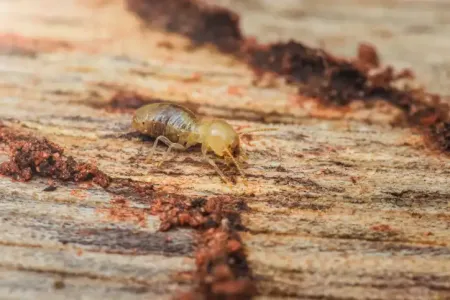
Some are 7⁄16” light yellow in color with clear, uniformly transparent wings; and they swarm at night. Other species are slightly longer; and reproductives have dark bodies and tannish-brown or colorless wings; and they swarm in the daytime. Soldiers of both species are about 5⁄16” and have dark brownish heads armed with strong mandibles.1
Usually, the first sign of a Drywood termite infestation is the presence of winged reproductives swarming from small openings. These termites lose their wings quickly after swarming, but the wings are important for proper identification. In structures, Drywood termites prefer to nest under wooden roof shingles, eaves or siding; or in nearby timber or brush. Another sign of infestation are piles of fecal matter from the termite, produced because they live within the wood.