
About Subterranean Termites
Usually a creamy brown color, with long narrow rounded bodies. About 1/8” in length. Short beaded antennae. Live primarily in underground colonies, and occasionally in moist secluded areas aboveground that can contain up to 2 million members. They build distinctive “mud tubes” to gain access to food sources and to protect themselves from open air. Termite colonies are organized into castes depending on tasks (i.e. workers, soldiers and reproductive).
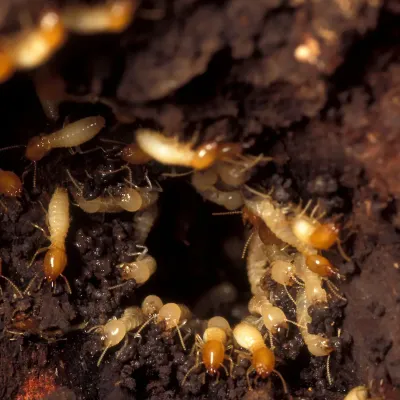
The characteristics of a subterranean termite depend on its role in the colony. The opaque cream-colored workers are 1/8” to 3/8” in length. Soldier subterranean termites are of a similar length, but are distinguished by their powerful mandibles with cream-colored bodies and dark heads. Reproductive subterranean termites are approximately one inch long and darker.
Subterranean termites live underground and build tunnels; and like other termite species, they feed on products containing cellulose. Subterranean termites swarm in the spring – groups of reproductive termites (called alates) are winged and leave to start new colonies.
Need contact with the soil to survive. They are capable of building tunnels through cracks in concrete. Subterranean termites are by far the most destructive species. With their damage, they can collapse a building entirely. The hard, saw-toothed jaws of termites work like shears and are able to bite off extremely small fragments of wood, one piece at a time.